Spring-Summer 2002 notes
July 2, 2002 - Death in Central Square:
Dana Laird killed when car door thrown open into bike lane
About
the Dana Laird fatality
- by John S. Allen
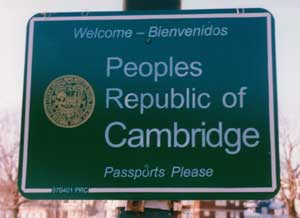
Remember this sign? Contrary
to the belief of some, I did not put it up on that fateful April
Fools Day several years ago. To my knowledge, nobody ever claimed
responsibility. If anyone knows the identity of the inspired person who posted it
or whatever became of the sign, I'd like to know. -- Robert Winters
Eastern painted turtles atop a
snapping turtle at Blair Pond, Cambridge near the Belmont border.
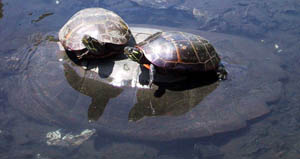
Photo courtesy of Roger Frymire |
The Charles
River Basin Master Plan is now available on the MDC (DCR) website
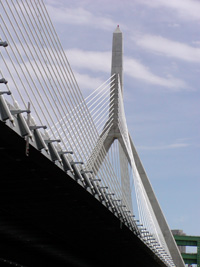
The Zakim Bridge (Apr 21)
interesting from any angle
|
June 2002 notes
June 27 - This was a Special City Council meeting
held at the Fletcher-Maynard Academy on Windsor Street. The sole topic of this
meeting was the increased violence in the Area 4 neighborhood, especially the
recent murder on Windsor Street.
Though one must certainly commend the City Council's
intentions in calling this meeting, the simple truth is that there is almost
nothing that the City Council can do as a body to affect the situation. As
individuals, each and every one of the elected officials can certainly take
steps as potential leaders to address the situation, but solutions are really in
the hands of the police department, the affected neighbors who have been less
than forthcoming in reporting incidents up to now, and among those who are
committing the violence and other criminal acts.
This is a societal problem, an economic problem, and
often a family problem. After tonight's meeting, I'm convinced that one thing
this is not is a political problem. The rhetoric from the councillors was
well-intentioned but of little practical value. Of much greater value was the
commentary from residents in the immediate neighborhood like Lorraine Scott,
Jackie Carroll, and especially Regina Jones. Though there was the usual share of
questionable accusation about more resources going to other neighborhoods, the
real message from these and other residents was that they refuse to accept any
more drug dealing, gun violence, stabbings, and other crime in their
neighborhood.
What is less than clear is whether the perpetrators
share this point of view. Hanging on the wall of the gymnasium where the meeting
was held was a sign that said “Attitude is BIG”. Though this was directed at
the schoolchildren at the Fletcher/Maynard, it struck me that maybe this is
really the issue more than the guns and drugs. As Regina Jones put it, “Drugs
are about a lifestyle. If the drugs don't get you, the lifestyle will.” Yes,
Regina, attitude is big.
Several things were clear from the remarks of Police
Commissioner Ronnie Watson. First, there has been less reporting of information
pertinent to these crimes and there needs to be more. Second, most of the recent
violence has not been random in nature but has been between people who
apparently know one another. This is important to keep in mind when fear starts
to creep in. As Commissioner Watson said, “Sometimes the fear is worse than
the actual incidents taking place.” Of some reassurance was the report of the
recent arrest of a person who had been trafficking in guns in Cambridge.
Commissioner Watson may be reached directly at
617-349-3378 or at ...... [Ronnie Watson has since retired.]
Dinner in Harvard Square: During a June 23 visit by my
friend Charlie (who I hadn't seen in 16 years), we got to talking about falcons
and hawks in cities. Later, we walked up to Harvard Square to have some dinner
at Grendel's. As we stood in front, a red-tail hawk nabbed a pigeon off the roof
of the House of Blues, swooped to about eye level right in front of us, and
disappeared down JFK Street with its catch. It was beautiful. -- Robert
Winters
The June 17 City Council meeting was scheduled to be
the last one until the July 29 midsummer meeting, but in the wake of yet another
murder in Area 4, there was a request from some councillors to schedule a
special meeting at a location in Area 4. The purpose of this special meeting
would be to address what appears to be a new wave of violent crime in Area 4.
Though it's not at all clear how a City Council meeting would impact the
problem, it should provide anxious residents an opportunity to express their
fears and concerns.
Public comment Monday night was almost exclusively on
the proposed order tabled from the June 10 meeting that called for a
reaffirmation of Cambridge as a “sanctuary city” and for City departments to
not cooperate with provisions of the federal USA
Patriot Act except where doing so would violate state or federal laws.
What makes this somewhat silly is that the USA Patriot Act is a
federal law, hence the order is effectively meaningless except as a political
statement. One after another public speaker told their personal tales of
repression in China, in the former Yugoslavia, during the McCarthy Era in the
United States, or of some personal acquaintance who was arrested, harassed, or
inconvenienced. It seemed a bit of stretch to compare the detention of
non-citizens suspected of having ties to terrorism to the internment of
Japanese-Americans families after Pearl Harbor, but such is the nature of
rhetorical zeal.
Eventually it was the Council's turn to crank out the
rhetoric as they took up the USA Patriot Act order after working their way
through the City Manager's Agenda. Adding to the drama was the news flash of the
murder that had just taken place on Windsor Street in Area 4. (It was reported
on the late night news that the name of the young man who was shot to death
while sitting in his car was Ricardo Williams, someone known to some of the
councillors.) How the debate on the USA Patriot Act became rhetorically linked
to the Area 4 murder was the product some new alchemy, yet there it was and
several councillors ratcheted up the emotional level of the debate by repeated
reference to the murder. The implied message was that unless an affirmative vote
was taken on the order right then and there, some other murder could happen in
Area 4, even though there is no connection between violent crime in Area 4 and
the provisions of the USA Patriot Act. Vice Mayor Davis' motion to refer the
matter to the Public Safety Committee for further clarification was welcomed by
Councillors Galluccio, Maher, and Toomey, but was beaten back by Councillors
Murphy, Decker, Reeves, and Simmons. Mayor Sullivan supported neither the main
motion nor Davis' motion to send it back to the shop for repairs. Ultimately,
several symbolic amendments by Vice Mayor Davis were passed and the order was
approved in a 5-4 vote. Supporters were joyous, and little if anything will
change in Cambridge as a result.
Pictures from the
June 13, 2002 Groundbreaking
at North Point Park
Notes from the June 10 City Council meeting:
Most of the public comment was on just a few
issues:
(1) A proposed order that would reiterate the "sanctuary city" policy
of Cambridge, oppose many provisions of the USA Patriot Act, and call for City
agencies (including the Police Dept.) to not cooperate with other government
entities in enforcement of the Act.
(2) A curb cut application on Sacramento Place opposed by most abutters.
(3) A proposal from the Public Health Commission to prohibit smoking in all
workplaces in Cambridge, including all bars and restaurants. [It's about time!]
(4) Geese.
Highlights of the meeting:
(1) Ken Reeves was almost charming in suggesting that the City Manager use some
of the available balances from FY02 to support the Central Square World's Fair
(which is in jeopardy).
(2) In response to a proposed amendment to the Noise
Ordinance that would penalize the idiots with obnoxiously loud sound systems
in their cars, Ken “Hip Hop” Reeves suggested that leaf blowers should also
be regulated.
(3) City Manager Robert Healy was a breath of fresh air when he answered Reeves'
inquiry about how he felt about the proposal to prohibit smoking in all
workplaces, including all bars and restaurants. Mr. Healy said simply, “I've
become a believer.” [This was my highlight of the year to date at City Hall.]
We'll soon be hearing from Joe “Middle East” Sater and John “Green Street
Grill” Clifford as they try to convince city councillors that they will be
driven out of business if the proposed ordinance passes. If this Council does
nothing else this term other than to pass this ordinance without amendment, it
will be a successful term. The proposal is now before the Ordinance Committee -
stay tuned.
Text of Proposed
Amendments to the Tobacco Ordinance
Boards of health and health departments from Boston,
Brookline, Cambridge, Chelsea, Everett, Malden, Medford, Newton, Revere,
Saugus, Somerville, and Watertown are joining together as a partnership, each
seeking to improve the health of their citizens and workers. Last year, the
Massachusetts the Supreme Judicial Court upheld the authority of cities and
towns to enact local laws that prohibit smoking, noting the scientific support
linking secondhand smoke to adverse health. Health advocates including:
American Cancer Society, American Heart Association, American Lung
Association, Asthma & Allergy Foundation, MA Association of Health Boards,
Mass Medical Society and the Boston Hotel Workers Union.
(4) The order calling for Cambridge
to not cooperate with the federal Patriot Act was tabled to the June 17
meeting by Councillor Decker's charter right. Prior to debate being cut off,
there were efforts from some councillors to amend the language, especially those
portions that may be problematic for the Cambridge Police. The order is really
just a reaffirmation of the 1985 City Council “sanctuary city” resolution
that called upon City departments to protect refugees by not cooperating with
other government agencies. Problematic aspects of the new resolution include,
among other things, requiring local police to release the names of any detainees
and to not permit surveillance, wiretaps, or the securing of private information
- even for suspected terrorists.
(5) Councillor Maher informed the public that long-time City Hall regular
William Jones is in the Mt. Auburn Hospital and is gravely ill after suffering a
stroke several weeks ago.
May 2002 Notes
May 13 City Council meeting
It wasn't a record. Mayor Sullivan brought the
gavel down after less than 50 minutes in uneventful City Council meeting that
was not all that different than other Council meetings this term. Perhaps that's
the real story - the citywide rezoning's all but done, rent control battles are
nowhere to be found, no new Starbucks stores have opened recently, and
there seem to be no big issues with which to grapple.
The only thing worth debating is who's going to shut
off the lights at the end of the meeting. Most of "the usual suspects"
who habitually speak during Monday Night Live's public comment period are
attending lefty organizing meetings or are at home watching Ally McBeal. Only
Roy Bercaw, Elie Yarden, and Bill Jones remain to hold down the fort at City
Hall.
If representative government is supposed to be just
that, i.e. representative, then perhaps all is well in Cambridge. Could this be
the time to consider changing from weekly City Council meetings to biweekly or
monthly meetings?
Harvard students
can keep their Cambridge resident parking permits (Harvard Crimson)
May 6 City Council meeting
There was some discussion on a proposed
new zoning amendment from the Community Development Department (CDD) that would
yield housing opportunities for moderate and middle-income homebuyers. CDD
Director Beth Rubenstein alluded to the matter of how much of a (density) bonus
would be required to yield these units and of some misgivings in CDD about
taking a citywide approach (as opposed to a case-by-case basis). Councillor
Davis referred the report from CDD to the Council's Housing Committee for a
larger discussion on this matter. Mayor Sullivan spoke to the need for an
underlying policy for how and when density bonuses would be granted. Such
density bonuses for middle and moderate income housing were a part of the East
Cambridge (ECPS) rezoning passed last December.
Councillor Galluccio recommended that this be done
under the umbrella of the Inclusionary Zoning Ordinance. The intended
beneficiaries would be those whose income lies between 80% and 120% of median
income. Federal money is unavailable above the 80% range. An incentive zoning
provision such as this would be entirely under the control of Cambridge
authorities.
Sidewalks, streetlamps, and backyards
Councillor Davis spoke on the
problem of deteriorating sidewalks throughout the city and what residents should
do if problems are discovered. DPW Commissioner Lisa Peterson reported that
sidewalk conditions are now being surveyed throughout the city. There are over
300 miles of sidewalks in the City of Cambridge. [As boring as this topic may
seem, it was a pleasant change from the previous week's discussion of the World
Bank and Abercrombie and Fitch T-shirts.]
Councillor Maher asked about maintenance of sidewalks
along MDC roads like Memorial Drive. The City Manager reported that these
problems are reported to the MDC, but that they often quote budget
concerns as the reason why they do not adequately address these problems. [Note:
While it can be said that the MDC does a very good job at major capital projects
like the new Charles River basin and the new pedestrian/bicycle paths further
upstream, they generally do a very poor job of routine maintenance of roads,
sidewalks and bridges. The condition of the BU Bridge, for example, borders on
the frightening. There are a number of places where lanes are striped narrower
than the width of vehicles, if you can believe that.]
Councillor Reeves suggested that DPW rubbish crews
would be ideal for reporting problems with city sidewalks. Councillor Galluccio
lamented the work of City contractors doing sidewalk replacement. Councillor
Decker asked about brick replacement on Magazine Street where bricks are popping
out and gaps are opening in the sidewalks. She asked about the policy of
replacing brick sidewalks with concrete sidewalks. The DPW would prefer concrete
for ease of maintenance, but property owners are generally given the option of
retaining brick sidewalks.
Though sidewalks are the property of the City,
maintenance of sidewalks is the responsibility of the abutting property owner.
The City Manager expressed his preference for concrete sidewalks, though the
policy has developed over the years to retain brick unless the property owner
agrees to change to concrete. [Note: I remember hearing the brick vs. concrete
debate at City Hall during past city councils. Let's face it - those bricks are
a “Cambridge thing” and all the reasoning in the world will not change that.
So we stick with the bricks.]
Vice Mayor Davis responded to the
City Manager's report on the possibility of the City taking over the ownership
and maintenance of streetlights. The Manager reported that the City is moving
forward on this. There is a continuing problem of NSTAR not adequately
maintaining these lights, especially in the replacement of burnt-out bulbs. Vice
Mayor Davis also asked about possible energy-saving initiatives that might be
possible if Cambridge had control of these lights.
Councillor Murphy addresses three communications from
NSTAR giving their financial reports for 2001. These reports show a significant
decrease in funds for maintenance during a year when there were many complaints
about service.
Councillor Maher addressed an order
he introduced gently asking residents who have driveways to use them so
that their neighbors without driveways will be better able to find parking on
the street.
[Amen - I have no driveway and it is very aggravating to see people with
driveways and/or garages renting them out or not using them while the rest of us
have to struggle for a parking space.]
Councillor Reeves spoke about the
idea of residents taking down backyard and sideyard fences in order to create
better shared green space. This is a great idea, if people can be cooperative.
However, two old adages still apply: (1) “One bad apple can spoil the bunch”
(with or without the apple tree), and (2) “Good fences make good neighbors.”
The matter was referred to the Neighborhood and Long-Term Planning Committee for
further discussion. Councillor Davis noted that her yard is open in four
directions to her neighbors and that her neighbors regularly pass through each
others yards. Reference was made to "modernizing property laws,"
though the meaning of this were not elucidated.
There was one late policy order
opposing a proposed State budget amendment that would transfer control of MDC
parkways to the Mass Highway Department.
Go Green 2002
at Fresh Pond
Spring 2002 CUE newsletter
[CUE = Cambridge United for Education]
April 2002 Notes
April 29 City Council meeting
After public comment dominated by testimony on
various nefarious activities of the World Bank, the Cambridge City Council
passed two orders impacting the foreign policy of the Peoples’ Republic of
Cambridge (PRC). They voted to support the boycott of World Bank bonds and to
investigate any further actions that the PRC could do against the policies of
the World Bank.
In response to a rumor reported by Councillor
Reeves, CDD Director Beth Rubenstein reported that Harvard has no plans for a
second 18-story tower at Mather House. Reeves followed with further speculation
about future traffic impacts of the new Harvard residential building now under
construction on Western Ave. just across the Charles River. Ms. Rubenstein noted
that Harvard's analysis suggests a minimal impact.
Reeves also spoke of his positive impressions of the
facilitated meetings of the University Relations Committee. To this, committee
chair David Maher reports that there will be still another facilitated
“mini-meeting” prior to the public meeting in late May. That mini-meeting
will take place on May 20 at the conclusion of the regular City Council meeting.
Mr. Maher emphasized that the public is invited to both the May 20 meeting as
well as the previously scheduled meeting on Tues, May 28. [Two previous meetings
were not announced publicly, so this is a positive development.]
Reeves addressed what he called the “moribund”
nature of the Affirmative Action Advisory Committee and suggested that the
number of City employees on the committee is excessive.
Vice-Mayor Davis (whose birthday is on May 18) and
Councillor Reeves wandered on and on about the May "Golden Shoes"
campaign promoting walking.
Councillor Galluccio let it be known that he will soon
be proposing changes to Cambridge's Inclusionary Zoning Ordinance to address the
housing needs of moderate and middle-income families and individuals. Stay tuned
- this promises to be an interesting initiative.
Councillor Decker led the discussion on the order
calling on Abercrombie and Fitch to provide diversity training to its employees.
She called their actions “racist”. Reeves followed with his comments on
their “Two Wongs make a white” T-shirts and asked the City Clerk to write a
letter expressing the sense of the Council on this matter. To this, the City
Clerk said she felt it was not her place to speak for the Council. Reeves
countered that there might be a "drafting session" to write the letter
after the vote. Mayor Sullivan suggested that the Mayor's Office write
the letter and that the individual councillors could sign on to the letter (or
write one of their own).
Councillor Galluccio joined in condemning the use of
racial stereotypes to sell T-shirts and asked that the Council call on the
Harvard Living Wage Campaign to promote a boycott of the store. Vice-Mayor Davis
chimed in with her condemnation of the store's actions.
Councillor Reeves had an order calling on the City to
develop “Green Zones,” citing an example at Putnam and Pleasant Streets and
“a national movement to open up adjoining backyards into shared space.” He
characterized this as a response to canyonization, referring to some of MIT's
construction in Cambridgeport.
Councillor Reeves also reminded the Council about
former councillor Katherine Triantafillou's efforts in making Cambridge a
“domestic-violence-free-zone” and asked if additional resources may be
needed.
Councillor Davis reported on this
past weekend's Area 4 Safety Walk and especially of the need to keep the Market
Street Park safe for residents.
Councillor Reeves spoke of a troubling trend among City
youth. Kids will stop in local convenience store, buy a "Blunt" cigar,
replace the tobacco with marijuana, and then smoke it during the school day. He
said that virtually everyone in this demographic also has their own gun.
“There is a great lack of respect for individuals as well among these
individuals,” he said. Councillor Decker suggested that any discussion of this
problem must involve more than just department heads, e.g. youth workers and
coaches. She related stories of some of these characters congregating in parks
and intimidating people. Reeves suggested having a “youth summit” to draw
these individuals into a dialogue. “There is something afoot that we should be
aware of,” he said.
Councillor Davis noted that it's important to also
emphasize the good things about the young people of Cambridge. Councillor
Galluccio said this is not a problem unique to this generation. Each generation
has its at-risk population. He said there is a high number of young people who
live at home without adult supervision. He emphasized the need to establish
standards of behavior among city youth. “Suspension of students from school
does not address the underlying social problems. These kids are reaching out to
us and we're missing the call.”
Councillor Decker noted that the Kids’ Council has
requested funding for some sort of youth summit. “Some kids in Area 4 are
intimidating people in the parks. How are adults to negotiate these
spaces with these young people? How do these young people experience this
community.”
Saying that he is generally not an alarmist, Reeves
noted a recent shooting on Norfolk St. which “was lost.” [He was presumably
referring to its being overshadowed by the nearly simultaneous murder-suicide
that took place nearby.] He observed that rap artists and other successful
entrepreneurs do get the attention of these youth. He seemed to be suggesting
that Cambridge should invite one of the major rap stars to a proposed youth
summit. Not a bad idea.
Councillor Reeves addressed the
possibility that there might be no Central Square World's Fair this year. The
Arts Council appears to be involved, but there is no plan currently in place.
Mayor Sullivan questioned Vice-Mayor Davis' order
calling on Cambridge to send a representative to a DEP workshop on a
Pay-As-You-Throw program. (This is the name for a program where residents are
billed by weight or volume for their trash, but where recyclable materials are
collected at no cost.) Mayor Sullivan and Councillors Maher and Toomey
voted against inquiring further into such a program and the order passed on a
voice vote.
Vice-Mayor Davis announced that the
North Cambridge Arts Open Studios are taking place this coming weekend.
Late Policy orders:
(1) Decker, Galluccio - calling for revenue enhancement to offset education
cuts.
(2) Decker - urging the state legislature to restore fundiing for police
programs and after-school and other programs.
(3) Toomey - determine a suitable location for Harold "Red" Haley
Square.
Mayor Sullivan announced that there
will be a breakfast meeting this Friday at 10:00am with the Cambridge
legislative delegation. [The Open Meeting Law would seem to imply that this
meeting in the Mayor's Office is open to the public.]
Apr 22 Note: In the City Council agenda for the Apr 22
meeting there were the following two resolutions:
57. Resolution on the death
of Scott J. Saunders. Councillor Reeves and entire membership
58. Resolution on the death of Desiree Rose
Saunders. Councillor Reeves and entire membership
Ms. Saunders was murdered last week. Her murderer was Mr. Saunders.
(Read Eileen
McNamara's commentary in the Boston Globe.)
Question: Is it appropriate for the Cambridge City Council to pass a
death resolution for a murderer who then commits suicide?
The Public Need Not Attend
The materials for the April 22 City Council meeting
reveal something rather startling - three committee reports from "public
meetings" that were never publicly advertised. Apparently, the City
Council's new University Relations Committee met on March 26 and again on
April 5; and the Government Operation Committee met on April 12 to
discuss, among other things, the controversial proposal to provide personal
staff for city councillors. Councillor David Maher chaired all three committee
meetings.
Not surprisingly, no one from the public gave testimony
at any of these three meetings. It is doubtful that anyone from the public knew
that the meetings were even taking place.
The two University Relations Committee meetings were
facilitated meetings held at the Water Treatment Plant. Though the public
generally does not give testimony at such meetings, these facilitated meetings
have in the past been among the more informative and interesting meetings
conducted with city councillors. I am particularly reminded of some of the
Council's goal-setting meetings of the past.
The meeting of the Government Operations Committee was
especially egregious since one of the topics discussed at the meeting was a
controversial proposal to create personal staff for individual councillors. When
the same proposal was made two years ago, a number of residents attended and
gave testimony in opposition to the proposal (which led to ferocious responses
from several councillors). Had the April 12 meeting been publicly advertised, it
is likely that there would again have been testimony in opposition.
The April 12 committee report notes simply that “All
members present agreed that regardless of the merits of creation of such
positions, in light of the budget difficulties at the state level and other
effects of the downturn in the economy that will impact the city budget, this
would not be a good time to create such additional positions. Councillor Toomey
moved that the committee recommend that Order Number 9 of February 25, 2002,
requesting that the City Manager prepare a recommendation for full time staff
for each councillor, be withdrawn and that no further action be taken on this
matter. The motion was passed without objection on a voice vote.”
The three councillors present (Maher, Murphy, Toomey) then
voted to recommend to the Manager that present City Council staff salaries be
reviewed with the intention of raising those salaries.
April 12 - Still no decision
on school mergers/closings
The Cambridge School Committee last night discussed a number
of budget-related topics, yet The Biggest Thing, the 400 lb gorilla in their
midst, went unmentioned. Apparently, the controversy over which programs are to
be consolidated or moved and which school building or buildings are to be closed
will have to wait until after this year's budget cycle is complete.
By most accounts, this inevitable consolidation of programs
and schools during a time of declining enrollment in the Cambridge Public
Schools will have a significant impact on the School Department budget. It will
enable the school administration to better utilize its resources to provide a
better education to all of Cambridge's schoolchildren.
But then there is politics. Closing a school building is
never an easy choice. There will be controversy and there will be angry parents
and school employees who will defend their "turf." Nonetheless,
closure is inevitable and delay is inexcusable.
Listening to Superintendent of Schools Bobbie D-Alessandro
gives no clue as to what the new merger/closure policy and its consequences will
be. It also appears that School Committee members are in the dark on this very
important matter. The dance around the 400 lb gorilla is becoming almost
comical.
Maybe people are still feeling burned by the controversy
generated by the merger of the Fletcher and Maynard Schools into the
Fletcher-Maynard Academy. While this may be understandable, delay and indecision
on the next merger should not be an option.
Robert Winters
April 9, 2002 - SJC
rejects Cambridge challenge to House map (Boston Globe)
Return to Cambridge Civic Journal